Case study contents
Results summary
The measurements below describe three separate operational comparisons inside the same Magento business. Each comparison uses the prior process for that task as its baseline.
Year-end inventory
A 4,500 SKU count required 20 fewer hours, a 47% reduction in elapsed work time.
Average pick time
Four picks were timed in 2025 on the same mobile scanner, from first item scan to last item scan.
Receiving item time
Six orders were timed from opening the first box through completing the invoice comparison.
The strongest result was the year-end count because both elapsed times are known: 42 hours before and 22 hours after. Picking is the average across four timed picks. Receiving is the highest observed improvement across six measured orders and is explicitly qualified by order size.
Operating environment
| Commerce platform | Magento 2 production store |
|---|---|
| Business | Anonymous specialty ecommerce retailer |
| Year-end count scope | Approximately 4,500 physical SKUs |
| 2025 picking catalog | More than 5,000 active SKUs |
| Measured by | One regular operator |
| Order workflow | Veeqo orders with local totals-based batch picking |
| Mobile hardware | Android scanner phone purchased from Veeqo |
| Scanner input | Single keyboard event with a Tab terminator |
| Interfaces | Responsive mobile scanner and desktop web views |
What changed in the workflow
Scan before search
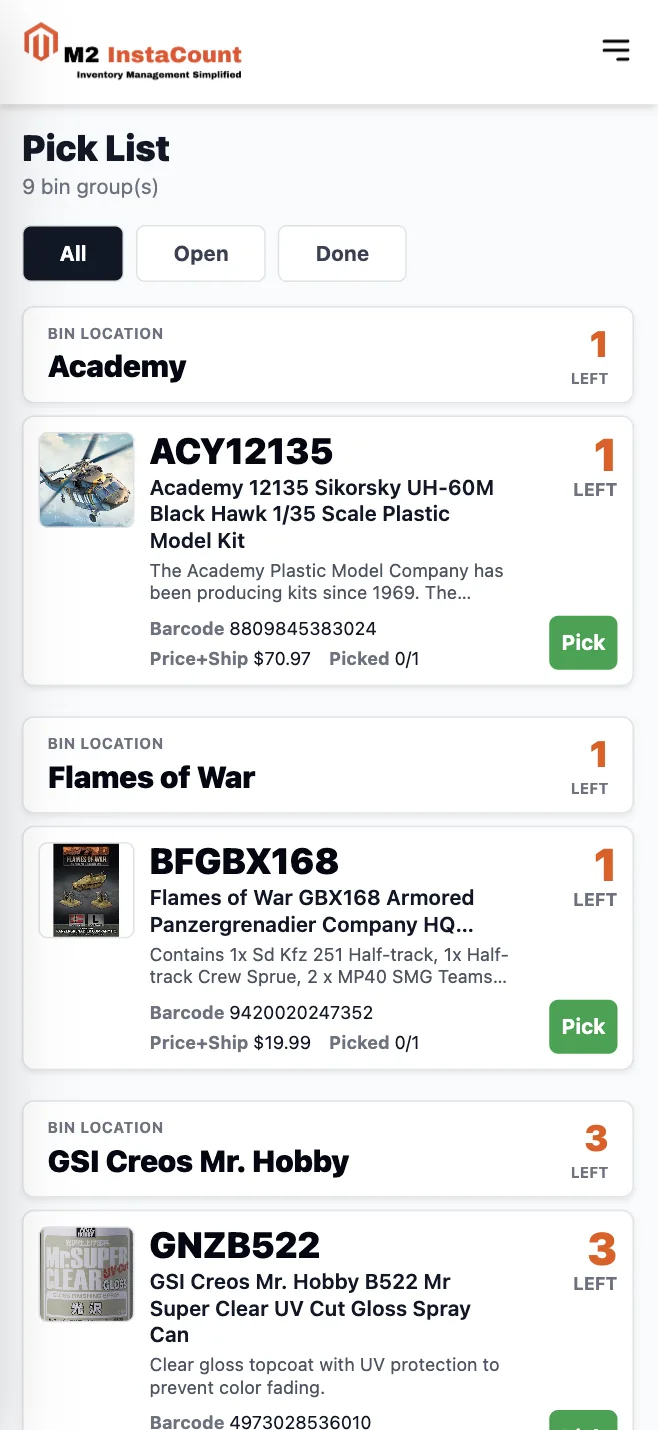
The barcode became the first action. Magento product data then supplied the SKU, title, image, description, price, and quantity context.
Put exceptions in the workflow
Unknown Magento products, wrong-item scans, quantity differences, and other exceptions became visible while the item was still nearby.
Reduce repeated navigation
Receiving history persisted, pick rows were grouped by bin and SKU, and scanner input worked without focusing a visible field.
Workflow evidence
These are current product views from the same workflows described in this case study. They show the information available to an operator during receiving and picking.

Methodology and reporting limits
This case study reports before-and-after operational observations from one anonymous production retailer. One regular operator performed the timed comparisons. This is not a randomized study, and it does not claim that every Magento store will achieve the same result.
- Year-end inventory: compares the known prior 42-hour process with a 22-hour barcode-first process across an approximately 4,500 SKU catalog.
- Picking: four picks were timed in 2025 while the catalog contained more than 5,000 active SKUs. Each timer started with the first item scan and stopped with the last item scan. Average elapsed pick time was 22% lower with M2 InstaCount than with native Veeqo picking on the same Android scanner phone.
- Observed picking baseline: in this operation, the operator encountered recurring native Veeqo app errors and interruptions during normal use, as well as a workflow that required more steps. This is an account of one operation, not a claim about every Veeqo user.
- Receiving: six orders were measured. Timing started when the first box was opened and ended after the scanned results were compared with the invoice. The manual baseline used checkmarks on a paper invoice.
- Order-size effect: the largest receiving improvements occurred on larger orders. With paper review, the operator had to search more invoice lines and separate items by SKU to verify quantities. The reported 53% improvement is the highest observed result, not the average across all six orders.
- Public reporting limit: individual order sizes, exact per-run times, and the retailer's identity are not published.
- Scope: the measurements describe workflow speed, not inventory accuracy percentages, revenue increases, or guaranteed savings.
Important product boundaries
M2 InstaCount is a focused operating layer, not a complete warehouse management system.
- Receiving confirms products, tracks quantities, persists work, and exports CSV data. It does not currently present automatic Magento inventory write-back as a production feature.
- Veeqo picking uses tagged orders and a local totals-based pick batch. It does not reproduce Veeqo's private native picked-line state.
- Magento remains the source for catalog and inventory data.
- An operator retains the review and completion steps required by the store's normal process.
FAQ
Was this a controlled inventory study?
No. These are before-and-after observations from one Magento production operation. They are useful operational evidence, but they are not a randomized or controlled experiment.
How was picking time measured?
Four picks were timed in 2025 by one operator. Each pick started with the first item scan and ended with the last item scan. Average elapsed pick time was 22% lower with M2 InstaCount than with the native Veeqo picking workflow on the same scanner phone.
How was receiving time measured?
Six orders were measured. Timing began when the first box was opened and ended after the results were compared with the invoice. The manual baseline used checkmarks on a paper invoice.
What barcode scanner was used?
The picking comparison used the same Android scanner phone purchased from Veeqo for both workflows. It was configured to send a single keyboard event with a Tab terminator.
Does receiving automatically update Magento inventory?
No. The current receiving workflow is designed for scan confirmation, quantity tracking, persistence, and CSV export for review.